
Samurai Champloo | Samurai Champloo Wiki
Samurai Champloo (サムライチャンプルー, Samurai Chanpurū?) is a Japanese anime series developed by Manglobe. It featured a production team led by director Shinichirō Watanabe, character designer Kazuto Nakazawa and mechanical designer Mahiro Maeda. Samurai Champloo was Watanabe’s first directorial effort…
Samurai Champloo
(サムライチャンプルー
,
Samurai Chanpurū
?
anime
Manglobe
. It featured a production team led by director
Shinichirō Watanabe
Kazuto Nakazawa
Mahiro Maeda
.
Samurai Champloo
was Watanabe’s first directorial effort for an anime
television series
after the critically acclaimed
Cowboy Bebop
. It was broadcast in Japan on
Fuji TV
on May 20, 2004 and ran for twenty-six episodes until its conclusion on March 19, 2005.
The story is set during a fictional version of Japan in the
Edo period
anachronistic
hip-hop
, setting.
[1
]
It follows
Mugen
and
Jin
, two vagrant
swordsmen
, who are rescued from execution by
Fuu
, a young ditzy barmaid, who then recruits them to accompany her in her quest across Japan to find the ”
samurai
who smells of sunflowers”.
Samurai Champloo
was critically acclaimed, and the series was dubbed in the
English language
Geneon Entertainment
(then Pioneer Entertainment) for releases in North America.
Funimation Entertainment
began licensing the series after Geneon ceased production of its titles. It was also licensed for English releases in the United Kingdom by
MVM Films
, and in Australia and New Zealand by
Madman Entertainment
.
Contents
Production
[
edit
|
edit source
]
Samurai Champloo
is considered to be an example of the popular
chanbara
film and television genre. Trademarks include the Edo setting, a focus on samurai or other swordsman characters, and lots of thrilling, dramatic fights.
[3
]
Chanbara
was used in the early days of Japanese cinema (when government political censorship ran high) as a way of expressing veiled social critiques.
[
citation needed
]
The word
champloo
Okinawan
word
chanpurū
(as in
gōyā chanpurū
, the Okinawan stir-fry dish containing
bitter melon
).
Chanpurū
, alone, simply means “to mix” or “to hash.”
Main Characters
[
edit
|
edit source
]
In
Samurai Champloo
there are three main characters which are
Mugen
,
Jin
, and
Fuu
.
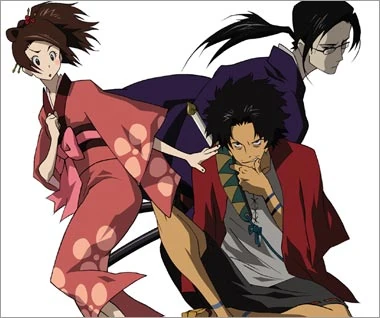
They all meet by a chance encounter in a little food shop ran by Fuu and an elderly couple. The three of them end up embarking on a journey in search of the “Sunflower Samurai”.
Plot
[
edit
|
edit source
]
Samurai Champloo
tells the story of three strangers in the
Tokugawa era
Edo Period
) who come together on a journey across Japan.
A young woman named Fuu is working as a waitress in a tea shop when she is harassed by a band of samurai. She is saved by Mugen, a mysterious rogue, and Jin, a young
ronin
. Mugen attacks Jin after he proves to be a worthy opponent and they begin fighting one another and inadvertently cause the death of
Shibui Tomonoshina
, the magistrate’s son. For this crime they are to be executed. With help from Fuu, they escape, though Fuu insists that they travel with her to find “the samurai who smells of sunflowers.” They agree to join her, with Fuu setting the condition that they are not to duel one another until the journey is done.
Setting and Style
[
edit
|
edit source
]
Samurai Champloo
blend
Edo period
backdrops with modern styles and references. The show relies on factual events of Edo-era Japan, such as the
Shimabara Rebellion
(“Unholy Union;” “Evanescent Encounter, Part I”),
Dutch exclusivity
in an era in which an edict restricted Japanese foreign relations (“Stranger Searching”),
Ukiyo-e
paintings (“Artistic Anarchy”), and fictionalized versions of real-life Edo personalities like
Mariya Enshirou
Miyamoto Musashi
(“Elegy of Entrapment, Verse 2”).
Incorporated within this scheme are signature elements of modernity, especially hip hop culture, such as
rapping
(“Lullabies of the Lost, Verse 1”), bandits behaving like “gangstas” (both parts of “Misguided Miscreants”),
censorship
bleeps replaced with record scratching, and much of Mugen’s character design.
Samurai Champloo’
musical score
predominantly features hip hop music produced by
Tsutchie
Nujabes
Fat Jon
FORCE OF NATURE
Shing02
MINMI
are also featured in the opening and ending themes, respectively
Anime
[
edit
|
edit source
]
Samurai Champloo
premiered in Japan on May 20, 2004 on
Fuji Television
, and concluded on March 19, 2005, spanning a total of 26 episodes. It was also aired in Japan on
Animax
.
Geneon
, licensed the show for distribution in North America almost a year prior to the show’s airing in Japan. An English
dub
of the series premiered in the United States on the
Adult Swim
anime block on May 14, 2005. The version aired was edited and had foul language replaced with sound effects, in addition to cutting out blood and nudity. The final first run of the episodes concluded on March 18, 2006.
Samurai Champloo
debuted in Canada on December 24, 2006, on the digital station
Razer
. The series has also aired in the United Kingdom,
Latin America
, Australia, New Zealand, Poland, Mexico, Portugal, Spain and Germany.
Funimation
has recently announced to distribute
Samurai Champloo
Geneon
since they have ceased in-house distribution of their titles in 2007. Geneon, in association with Funimation, re-released the entire 26-episode anime series in a box set in June 2009 and on
Blu-ray
in November 2009.
[4
]
As of November 26, 2010, Funimation has fully licensed the series and will once again release the series under the Classics line on May 24, 2011.
[5
]
The anime series made its return to US television on
FUNimation Channel
starting March 21st, 2011.
[6
]
The episodes use six pieces of theme music. “Battlecry”, performed by
Nujabes
Shing02
, is the opening theme for all twenty six episodes. “四季ノ唄
(Shiki no Uta
,
Song of Four Seasons
?
Minmi
is the primary ending theme, except for four episodes. Episode 12 uses Minmi’s “Who’s Theme” as its ending, episode 17 uses “You” by Kazami, 23 uses “Fly” by
Azuma Riki
, and the final episode uses the song “San Francisco” by
Midicronica
.
Manga
[
edit
|
edit source
]
A
Samurai Champloo
manga
debuted in
Shōnen Ace
Tokyopop
licensed the manga in an English-language release in North America and
Madman Entertainment
lit for an English release in Australia and New Zealand. It is also licensed for a Portuguese-language and Spanish-language release in
Brazil
Spain
by Panini. There are 2 volumes in this series.
Unlike many anime series,
Samurai Champloo
did not originate with a manga; rather, the manga was created after the anime and is to some degree based on it.There have been two series of Champloo volumes falling under the “manga” heading:
the Japanese manga, published by Manglobe in 2004, written and illustrated by Masaru Gotsubo; and
the short-lived “film manga” project released by Bandai in the USA.
The Manglobe manga ran only two issues. The first issue contained four chapters, the first one being an adaptation of the first episode of the series, the others being original stories by manga-ka Gotsubo. The second volume was all original stories. Manglobe’s manga was picked up for English translation and North American distribution by Tokyopop in 2005. The first volume was issued in the USA in November 2005 and the second in March 2006
Bandai’s
Champloo
film manga was announced with great optimism in January 2006. This format, called “photocomics” or “fumetti” elsewhere in the world, tells the story of a movie or anime using actual frames from the film instead of artwork.
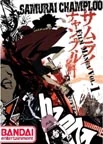
Vol. 1 of Bandai’s “film manga”
In their press release of January 25th, 2006, Bandai Manga Editor Robert Napton said, ”
Samurai Champloo
is one of today’s hit anime properties and when the chance to license a series of Film Mangas from Geneon came our way, we jumped at it.” He admitted that “Film Manga as a format has had a bit of a turbulent ride in America, mostly due to bad quality and high price points,” but added, “We are battling that by releasing each volume featuring high-quality color images and the very competitive price of $9.99 per volume.” In addition to adapting three episodes of the anime, each Film Manga volume was to include exclusive bonus material not found anywhere else, the first volume featuring an interview with Director Shinichiro Watanabe. “For each volume, we want to have more than just episodes; we go behind the scenes of the series, like bonus features on a DVD,” Napton said.
The series was planned to run nine volumes, containing the entire anime at three episodes per book, but by July 2008, only three volumes had been released and no further volumes followed. All three are listed at collectors’ sites as “out of print” and “not available from publisher”, and are very difficult to find even on the secondary market.
Misc
[
edit
|
edit source
]
Soundtracks
[
edit
|
edit source
]
Music used in the series was released across four CD
soundtracks
Victor Entertainment
. The first,
Samurai Champloo Music Record: Masta
, was released on June 23, 2004. Produced by
Shinichirō Watanabe
Tsutchie
hip hop
duo Force of Nature,
[7
]
[
verification needed
]
the album features 18 instrumental tracks and one mid-tempo ballad sung by
R&B
songstress Kazami.
Samurai Champloo Music Record: Departure
was released on the same date, containing 17 tracks, with two being vocal pieces performed by
rap
Shing02
R&B
Minmi
. The album was produced by the late Japanese DJ/producer
Nujabes
Fat Jon
.
[7
]
Two additional soundtracks followed on September 22, 2004.
Samurai Champloo Music Record: Playlist
contained an additional 18 tracks, all created by Tsutchie, with only one being a vocal piece: a remix of the first album’s song “Fly,” performed by
Azuma Riki
of the hip hop group
Small Circle of Friends
[7
]
. The final album,
Samurai Champloo Music Record: Impression
, features 23 tracks from Force of Nature, Nujabes, and Fat Jon. Rap artists Suiken and S-word, members of Tokyo rap group
Nitro Microphone Underground
, provide guest vocals and Minmi performs the final song on the album.
[7
]
Two separate soundtracks,
Samurai Champloo Music Record: Katana
as well as
Samurai Champloo Music Record: Playlist
Geneon Entertainment
only in North America. They bear most of the same tracks as the Japanese albums.
Video Game
[
edit
|
edit source
]
Grasshopper Manufacture
video game
PlayStation 2
entitled
Samurai Champloo: Sidetracked
; however, the manufacturer has stated that the game has no relation to the show. It was released on April 11, 2006, in the United States and received mixed reviews.
[8
]
The game is notable for giving Mugen’s distinctive sword a name, “Typhoon Swell”; it was never called by this name in the anime or manga series